Every abandoned cart is lost revenue. Every slow page costs conversions. Every confusing checkout loses customers. As a dedicated e-commerce web design agency, we build experiences that turn your traffic into transactions.
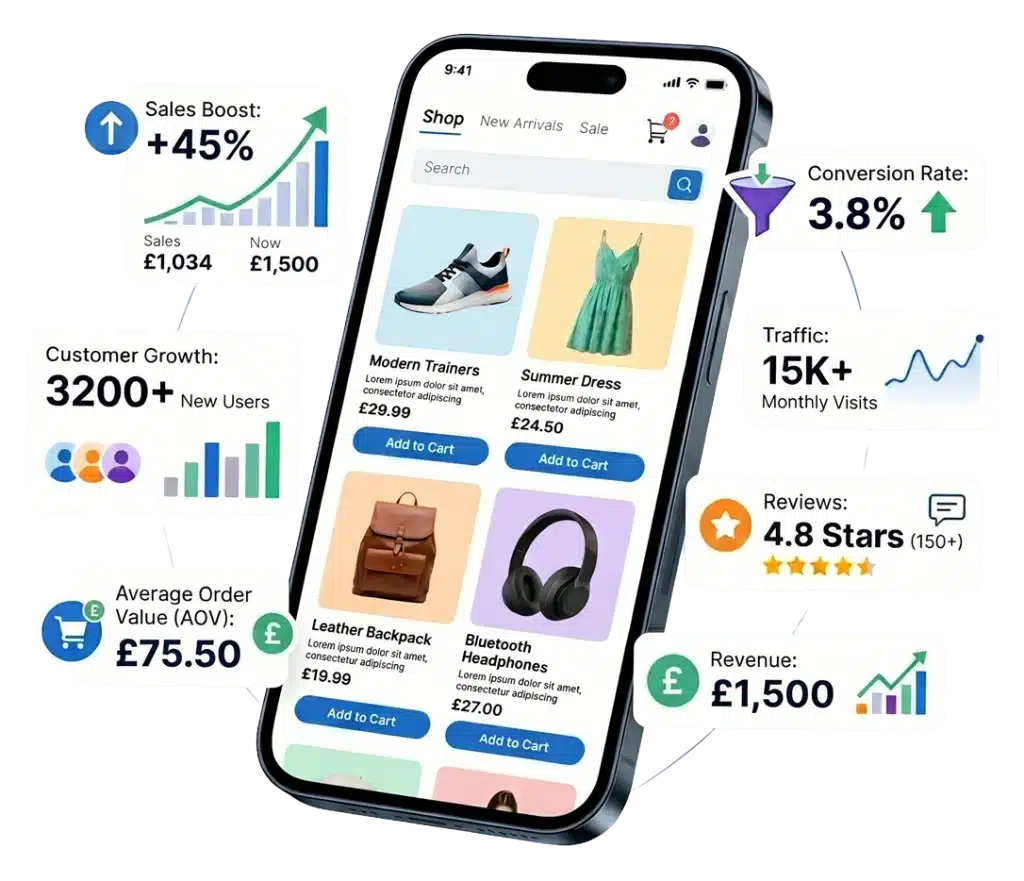
Your online store competes with Amazon’s convenience, ASOS’s experience, and every other site just one tab away.
…you’re not just losing sales. You’re training customers to shop elsewhere.
E-commerce demands unique considerations:
Helping customers find what they didn't know they wanted
Overcoming the hesitation of buying from strangers online
Understanding the micro-decisions that lead to purchase
Inventory, payments, shipping, taxes, returns
Every 100ms delay costs 1% in sales
Generic web design won’t cut it. E-commerce needs an e-commerce web design agency that understands both retail psychology and digital technology.
Best for Businesses wanting proven e-commerce infrastructure with flexibility
Harness the world’s leading e-commerce platform with custom design that stands out from the crowd.
Best for Businesses needing complete control and custom functionality
Transform WordPress into a powerful selling machine with unlimited customisation potential.
Best for Unique business models or complex requirements
When off-the-shelf platforms limit your vision, we build exactly what you need.
Best for Stores outgrowing their current platform
Move to a better platform without losing momentum, customers, or SEO rankings.
A proven approach that delivers on time and on budget
Revenue Analysis & Strategy
We start by understanding your products, customers, and competition. What’s working? What’s not? Where’s the opportunity?
User Experience Mapping
Designing customer journeys that reduce friction and increase desire. Every click should move toward conversion.
Visual Design & Branding
Creating designs that build trust, showcase products perfectly, and reflect your brand’s unique value.
Development & Integration
Building robust systems that handle traffic spikes, integrate with your tools, and scale with growth.
Testing & Optimisation
Rigorous testing across devices, payment methods, and user scenarios. Launch strong, then continuously improve.
Electrical Products Manufacturer
Building a digital platform to match Hispec's reputation as one of the UK's fastest-growing electrical wholesalers
Custom WordPress/WooCommerce build with trade-only access controls, Sage integration, and comprehensive on-site optimisation engineered for organic discoverability
Trade-only registration portal, Digital signature credit applications, Role-based pricing visibility, Sage invoicing integration, MailChimp automation, Full schema markup, GDPR compliance
All packages include:

Best for Most retailers, especially fashion, lifestyle, and direct-to-consumer brands

Best for Businesses wanting flexibility and already using WordPress

Best for Unique business models or specific technical requirements
Most UK stores start with one of three real build routes, and the right one depends on how much your catalogue, brand and operations need to flex rather than on budget alone.
A themed or template build starts from an existing platform theme (Shopify or WooCommerce) and customises layout, colours and key pages around it. It’s the fastest route to a working store and suits businesses with a straightforward catalogue and standard checkout needs. The trade-off is flexibility: you’re working within what the theme’s structure allows, so highly specific merchandising or unusual product configurators can be harder to achieve cleanly.
A custom-designed theme keeps the same underlying platform but builds the front end from scratch around your brand and your customers’ buying journey. This suits stores where product presentation, category structure or conversion paths genuinely need something bespoke. It takes more design and build time than a template, but gives you a site that looks and behaves like nobody else’s, while still sitting on a platform you can manage day to day.
Headless or composite builds separate the front end from the commerce engine entirely, calling in payments, inventory and content through APIs. This is the route for businesses with complex integrations, multiple sales channels, or content-heavy sites where page speed and design freedom matter more than ease of in-house editing. It’s the most flexible option, and usually the slowest and most technically involved to build and maintain.
As an ecommerce web design agency, we scope which route fits before any design work starts, since the wrong build route costs more to unpick later than it does to choose properly at the outset.
An e-commerce build moves through a consistent set of phases, though how long each one takes depends heavily on how ready your business is behind the scenes, not just on the design work itself.
Discovery typically comes first, mapping your catalogue, customer journey and any integrations you’ll need, such as payments, couriers, accounting and stock systems. Design follows, usually starting with key templates like the homepage, category and product pages before extending across the full site. Build and development happen alongside this, turning approved designs into a working store on your chosen platform.
Product data and migration is often the phase that stretches furthest. Moving descriptions, images, variants and historic order or customer data across cleanly takes longer when the source data is inconsistent or spread across spreadsheets and multiple systems, so it’s worth starting this early rather than leaving it until the end. Payments, shipping rules and tax setup usually run alongside build too, since they need testing against real scenarios rather than being configured once and left.
Testing covers checkout flows, payment methods, mobile behaviour and edge cases like out-of-stock or multi-currency scenarios, before launch itself, which typically includes a period of close monitoring.
In practice, the phases that most often extend a timeline aren’t design or development, they’re product data quality, the number of third-party integrations, and how much new content, copy, imagery, category descriptions, still needs writing when the build starts. Getting these moving early is usually the single biggest lever you have over how smoothly the rest of the build runs.
Shopify and WooCommerce are both credible choices for a UK SME store, and the right one usually comes down to a handful of practical factors rather than personal preference.
Catalogue size and complexity matter first. A smaller, well-structured catalogue tends to sit comfortably on either platform, but larger or highly variable catalogues, with lots of variants, bundles or configurable products, often run more smoothly on WooCommerce, where the underlying WordPress structure gives more room to adapt.
Ownership and hosting control is the next factor. WooCommerce is self-hosted, so you, or your agency, control the server, backups and updates directly, which suits businesses that want that level of control or already run WordPress for content. Shopify is hosted for you, trading some of that control for less day-to-day maintenance responsibility.
If you sell to trade or business customers, B2B needs matter too. Both platforms support account-gated pricing and bulk ordering through native features or plugins, but the maturity and cost of that functionality differs, so it’s worth scoping your specific B2B workflow before choosing.
Integrations are the other deciding factor. Check how well each platform’s app or plugin ecosystem supports the UK couriers, payment providers and accounting software you already use, since a mismatch here creates ongoing manual work later. Ongoing cost models also differ, a monthly subscription plus apps for Shopify, hosting plus plugins for WooCommerce, and it’s worth weighing that against your team’s technical comfort.
If you’re weighing up ecommerce website design in Lancashire, being based here ourselves means an in-person discovery session is always an option alongside remote calls.
It depends on your products, budget, and growth plans. Shopify is fastest to market, WooCommerce offers most flexibility, and custom builds provide complete control. We’ll recommend the best fit during consultation.
Typically 8-12 weeks for standard stores, 12-16 weeks for complex requirements. We can fast-track urgent projects when needed.
Yes. We’ve successfully migrated stores from every major platform without losing data, customers, or SEO rankings.
Beyond our design fee, consider platform fees (Shopify: £25-299/month), hosting (WooCommerce: £50-200/month), payment processing (2.4-2.9% + 20p), and any premium apps/plugins.
We partner with professional product photographers or can recommend trusted suppliers. Great product images are crucial for conversions.
Yes. We regularly integrate with systems like NetSuite, SAP, TradeGecko, and custom databases.
We build multi-currency, multi-language stores with appropriate tax and shipping configurations for international commerce.
Yes. We’re based at Strawberry Fields Digital Hub in Chorley and build e-commerce websites for retailers across Lancashire as well as brands selling nationally, often alongside our national SEO services. Most stores are built on Shopify or WooCommerce, depending on the catalogue, the payment and delivery setup, and how much control you want over the design. Being local means kickoff and review sessions can happen in person.
A store migration is planned as a joint design and SEO exercise, not treated as a side effect of the build. That means mapping every existing URL to its new equivalent, setting up permanent redirects, carrying over page titles and metadata that are already performing, and checking indexing closely after launch to catch issues early. Migrations carry inherent SEO risk if they’re rushed, so our e-commerce SEO team is involved in planning the URL structure before the build starts, not just afterwards.
Yes. Trade and B2B e-commerce typically needs features a standard consumer store doesn’t: account-gated catalogues so pricing only shows to approved trade customers, tiered or quantity-based pricing, minimum order quantities, and sometimes a quote-based checkout instead of instant payment. Both Shopify and WooCommerce support this through native features or established plugins, and we scope your specific trade workflow, approval process and pricing tiers during discovery, so the platform choice and build reflect how your trade customers actually order.
Launch isn’t the end point, it’s when real customer behaviour starts showing you what to refine. We typically monitor checkout completion, page speed and any error reports closely in the days after going live, then move into a steadier cycle of small improvements based on how visitors actually use the site. Many businesses move onto ongoing website maintenance at this stage, covering updates, backups and monitoring, so the store keeps running smoothly without you having to manage that yourself.
UK e-commerce is worth £693 billion and growing. Every day without a high-performing online store is market share lost to competitors.
The question isn’t whether to sell online, but how to do it better than everyone else.

We measure success in sales, not just site launches. Every decision is guided by its impact on your bottom line.
Not tied to one solution. We recommend and build on the platform that best serves your business goals.
CRO isn't an afterthought—it's embedded in every design decision from day one.
Your e-commerce site should flourish as your business grows, not become a constraint.
Launch is just the beginning. We're here for continuous improvement, seasonal updates, and strategic growth.
Your competitors are capturing customers 24/7. Your e-commerce site should be your hardest-working sales channel.
Transform your online store from cost centre to profit engine.