
Technical SEO That Fixes
What's Holding Your Rankings Back.
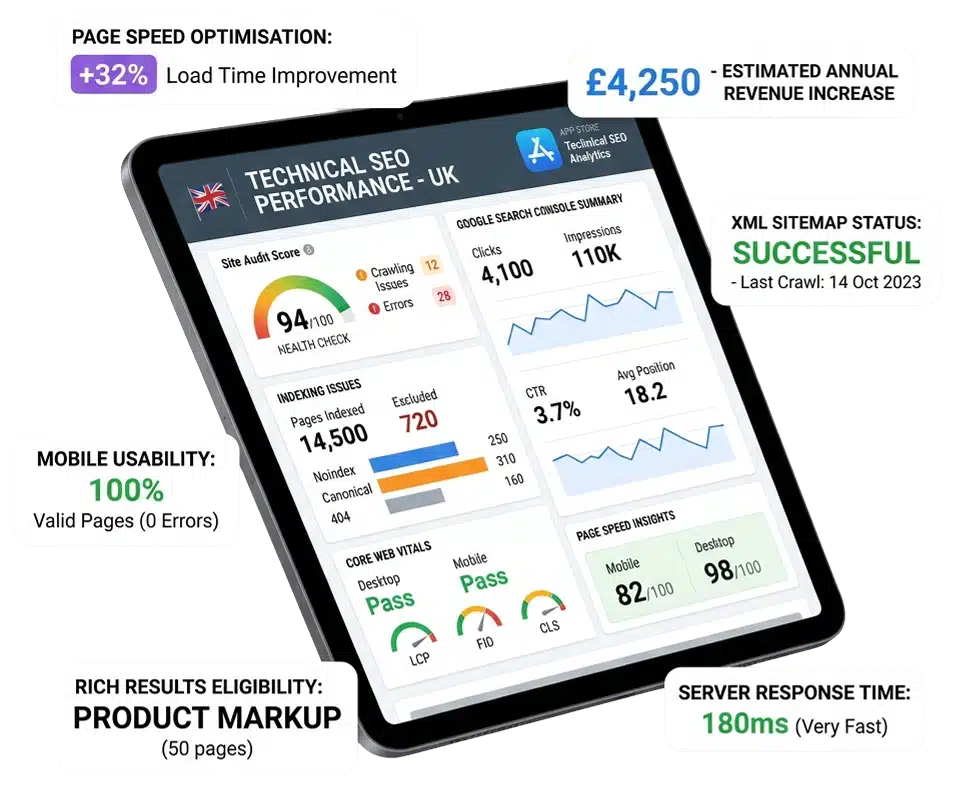
Your content might be perfect. Your links might be strong. But if Google can’t properly crawl, understand, or display your site, none of that matters. We dig deep to uncover the technical issues costing you traffic.
Sites
Audited
Core Web
Vitals Specialists
Average 40%
Traffic Lift Post-Fix
Years
Technical Expertise
Why Technical SEO Can't Be Ignored
You could have the best content and strongest backlinks in your industry. But if Google struggles to crawl, understand, or rank your pages, you’re leaving traffic—and revenue—on the table.
Common symptoms of technical issues:
Rankings that won't budge despite great content
Pages that won't get indexed
Traffic drops after site changes
Poor performance on mobile
Competitors outranking you with weaker content
A technical SEO audit gives you the roadmap to fix what’s broken and unlock your site’s true potential.
What We Analyse.
Our technical audits examine every aspect of your site’s foundation:
Crawlability & Indexation
- Are search engines finding all your important pages?
- Is crawl budget being wasted on low-value URLs?
- Are robots.txt and XML sitemaps configured correctly?
Site Speed & Core Web Vitals
- Load times across devices and locations
- Largest Contentful Paint (LCP)
- First Input Delay (FID) / Interaction to Next Paint (INP)
- Cumulative Layout Shift (CLS)
Mobile Performance
- Responsive design implementation
- Mobile usability issues
- Touch target sizing
- Mobile-first indexing readiness
Site Architecture & Internal Linking
- URL structure and hierarchy
- Internal link distribution
- Orphaned pages
- Link equity flow
Technical Implementation
- JavaScript rendering issues
- Schema markup and structured data
- Canonical tags and duplicate content
- International SEO (hreflang)
- HTTPS and security issues
Who Needs a Technical Audit.
Our technical SEO audits deliver clarity for:
Sites with stagnant rankings despite good content
Post-migration websites experiencing traffic drops
E-commerce stores with complex product catalogues
Growing businesses before major site changes
Enterprise sites with thousands of pages
Anyone serious about maximising organic potential
What Technical SEO Is (and What It Is Not).
Technical SEO is the work that makes a website easy for search engines to crawl, render, index and serve quickly. It sits alongside two other pillars of SEO: content, which is what your pages say, and authority, which is who links to you and how trusted your domain is. Technical SEO does not replace either of these, it makes sure they get a fair chance to work.
A site with excellent content can still be invisible in search results if Googlebot cannot reach the pages, if the server is slow, or if the page renders differently for a crawler than it does for a visitor. That is the gap a technical SEO audit closes: it finds the barriers between your content and the search results, rather than judging whether the content itself is good.
- Technical SEO covers: crawlability, indexation, site speed, Core Web Vitals, mobile usability, structured data, URL structure and how a site is built.
- Technical SEO does not cover: content strategy (what you write and for which keywords) or link building (earning authority from other sites). Both sit within our wider SEO services.
Common Technical SEO Issues We Find and Fix.
A technical SEO audit does not stop at a checklist, it explains what each issue costs you and how it gets fixed. This is the core of our technical SEO services.
- Pages blocked by robots.txt or noindex by mistake: a leftover setting from development can block whole sections from Google, so those pages never appear in search.
- Duplicate URLs and missing canonicals: the same page reachable through several addresses splits ranking signals between them. A canonical tag tells Google which version counts.
- Redirect chains and 404s after a migration: website migration often leaves old URLs redirecting through several hops or not redirecting at all, wasting crawl budget and lost authority.
- Orphan pages with no internal links: pages nothing else links to are harder for Google to find, however good the content, so we map internal links properly.
- Slow Largest Contentful Paint and layout shift: these Core Web Vitals measure load speed and visual stability, and are often improved through performance optimisation.
- JavaScript-rendered content search engines cannot see: if key text or links only appear after JavaScript runs, some crawlers miss them entirely, so we check what Google actually renders.
- Broken or bloated XML sitemaps: a sitemap listing redirected, blocked or non-existent URLs wastes the crawl budget it exists to protect, so we rebuild it properly.
- Faceted navigation and parameter URLs wasting crawl budget: filter and sort options on e-commerce sites can generate thousands of near-duplicate URLs that bury the pages that matter.
- Structured data errors: invalid or missing schema markup means you miss out on rich results in search, so we validate markup against Google’s requirements.
- Mixed content and HTTPS issues: pages loading some resources over unencrypted http trigger browser warnings and can undermine trust, so we fix every insecure reference.
- Mobile usability failures: text too small, buttons too close together or content wider than the screen all count against a site under mobile-first indexing.
What to Expect After Technical SEO Fixes.
Technical fixes do not work like a light switch. Indexation and crawl errors usually improve within days to a few weeks, once Google has recrawled the pages you have changed. Core Web Vitals field data takes about 28 days to refresh in Google Search Console, because it is based on a rolling window of real visitor data.
Ranking and traffic changes typically follow over one to three months, and how much you see depends on how serious the original issues were, and on your content and links doing their part too. Technical SEO removes ceilings on what your site can achieve, it does not create demand for a product or service that was not there before. Older or more damaged sites usually see the biggest movement.
We check progress through Search Console coverage and Core Web Vitals reports, and by comparing crawl data or log files from before and after the fix. We recommend a re-check around a month after implementation, with a further review at three months to see the fuller picture.
The Technical Audit Process.
Initial Discovery
Understanding your goals and known issues
Recent result:
Client-reported issue led to finding 10,000 blocked pages
Comprehensive Crawl
Using enterprise tools to analyse your entire site
Recent result:
Discovered 3,000 duplicate pages wasting crawl budget
Manual Investigation
Human review catches what automated tools miss
Recent result:
Found JavaScript blocking 40% of content from Google
Priority Roadmap
Clear action plan ranked by impact and effort
Recent result:
Quick wins delivered 25% traffic increase in 30 days
Implementation Support
Optional help executing the recommendations
Recent result:
Guided fixes improved Core Web Vitals by 60%
What You Receive.
Comprehensive Audit Report
- Executive summary for stakeholders
- Detailed findings with screenshots
- Impact assessment for each issue
- Technical explanations in plain English
Prioritised Action Plan
- Quick wins for immediate impact
- High-priority fixes ranked by ROI
- Long-term improvements roadmap
- Resource requirements outlined
Live Review Session
- Screen-share walkthrough of findings
- Q&A with our technical team
- Developer-friendly documentation
- Clear next steps
Post-Audit Support
- 30 days of email support included
- Implementation guidance
- Re-crawl to verify fixes (optional)
- Ongoing monitoring setup advice
Transforming From Hidden to 8,500 Monthly Visitors with Technical SEO.
Client.
Health Technology E-commerce Brand
Project Highlights.
Challenge.
Competing in a specialised health tech market with limited online presence against established global players
Our Solution.
Technical audit, content optimisation, and backlink strategy capturing 1,096 SERP features across four international markets
- 8,500 Monthly Organic Visitors
- 10,963 Keywords Ranking
- 280 Top 3 Rankings
- 1,096 SERP Features Captured
- United States (74% traffic share)
- United Kingdom
- Canada
- Australia
Technical Audit Investment.
Technical SEO Audits – From £850 one-off
Our Technical SEO audits identify every issue blocking your site’s performance, with a clear roadmap for implementation.
Standard Audit
For small to mid-sized websites-
Full technical crawl
-
Site speed & Core Web Vitals analysis
-
Mobile optimisation review
-
Crawlability & indexing checks
-
Priority action plan
Advanced Audit
For large or complex websites-
All Standard Audit checks
-
In-depth structured data review
-
International SEO checks (if applicable)
-
CMS-specific recommendations
-
Implementation support
All audits include actionable recommendations and developer documentation
Get a full diagnostic report with actionable steps
Site Speed and Core Web Vitals Audits
Core Web Vitals measure what a page feels like to use, not just how fast it loads. Largest Contentful Paint (LCP) measures how long it takes for the biggest visible element, usually a hero image or heading, to appear on screen. Interaction to Next Paint (INP) measures how quickly the page responds once someone taps a button or link, replacing First Input Delay as the responsiveness metric. Cumulative Layout Shift (CLS) measures how much content jumps around as a page loads, which is what causes a visitor to tap the wrong thing because a banner or image loaded late.
On WordPress sites, the usual culprits are unoptimised images uploaded straight from a phone or camera, page builders that add extra layers of markup and CSS for every section, and render-blocking scripts loading before anything on screen is usable. Ecommerce sites add their own problems: product galleries with dozens of full-size images, filtering and review plugins that each load their own script, and third-party tags for chat widgets, ad pixels and review platforms stacking up until the page does far more work than the visitor needs.
A technical SEO audit does not fix every one of these at once. Fixes are prioritised against the pages that carry the most organic traffic or revenue, typically product, category and service pages, so effort goes where it moves the needle rather than into pages few visitors reach. Working out that order is what a technical SEO agency spends most of its time on. Where speed issues sit alongside plugin updates or hosting limits, that work often continues through website maintenance rather than as a one-off fix.
Crawl Budget and Index Management for Larger Sites
Crawl budget is the number of pages Googlebot will fetch from a site within a given period. For a site with a few dozen pages this is rarely a constraint, but once a site runs into thousands of URLs, what Google spends its budget on starts to matter. Faceted navigation is the usual cause: each colour, size or price filter a shopper applies can spin up its own web address, and a crawler working through every combination burns budget on near-identical pages rather than the products that matter. Parameter URLs from tracking tags or session variables create the same problem.
Pagination needs similar care. Long paginated series can bury older pages several clicks deep, and pages that are not signalled properly can fall out of the index altogether. A page can carry strong content and still sit invisible to Google if nothing else on the site links to it, since crawlers rely on links to find their way around. XML sitemaps and robots directives are the tools for managing all of this: sitemaps should list only the URLs worth indexing, and robots.txt or meta robots tags should keep low-value parameter and filter combinations out of the crawl queue without accidentally blocking pages that should rank.
Log-file analysis is how we confirm what is actually happening rather than guessing: server logs show exactly which URLs Googlebot requested, how often, and which pages it mostly ignores. For a small brochure site this level of detail is unnecessary. It earns its place on larger sites, ecommerce catalogues, and any business with national SEO ambitions, where the sheer number of location or category pages makes crawl efficiency a ranking factor in its own right.
Structured Data and Schema Implementation
Structured data is markup added to a page’s code that describes what the content means in a format search engines can parse directly, rather than inferring it from the visible text. For UK service businesses, the schema types that matter most are Organization and LocalBusiness, which confirm your name, address, contact details and opening hours, and Service schema, which describes what you offer. FAQ schema marks up question-and-answer content, and Breadcrumb schema describes where a page sits within the site’s structure. Ecommerce sites rely most heavily on Product schema, which carries price, availability and review data through to the search results.
Getting the markup right is only half the job. We validate it against Google’s structured data requirements before it goes live, then monitor it through Search Console’s enhancement reports, which flag when a schema type has errors or warnings that would stop a page qualifying for the rich result it targets. This kind of validation and monitoring is a standard part of our technical SEO services, alongside the crawlability and speed work covered elsewhere on this page.
It is worth being honest about what schema does and does not do. Valid structured data makes a page eligible for rich results, such as star ratings, FAQ dropdowns or breadcrumb trails in the search listing, and can improve click-through once a page is already ranking. It does not, on its own, raise where a page ranks. Search engines still weigh content quality, relevance and authority separately, so schema works alongside the rest of a technical SEO audit rather than replacing it.
Common Technical SEO Questions.
Do you need access to our site?
We need Google Search Console and Analytics access. CMS access helps but isn’t essential for the audit (though it speeds up implementation).
How long does an audit take?
Most audits are completed within 7-10 working days. Enterprise audits may take 15 working days due to complexity.
Will you fix the issues you find?
The audit identifies and prioritises issues. We can provide implementation support separately or work with your development team. For sites competing UK-wide, the technical fixes are usually the first phase of a national SEO campaign.
Can you audit very large sites?
Yes. We have processes and tools to efficiently audit sites with millions of pages, focusing on templates and patterns rather than individual pages.
What tools do you use?
We use enterprise tools including Screaming Frog, Sitebulb, PageSpeed Insights, and proprietary scripts, plus extensive manual checking.
Is one audit enough?
For most sites, yes. However, we recommend quarterly technical health checks for large or frequently-updated sites.
What is the difference between technical SEO and on-page SEO?
Technical SEO deals with how a site is built and served: crawlability, speed, indexing and rendering. On-page SEO deals with individual pages: titles, headings, keyword use and internal content optimisation. They overlap at the edges, for example page speed sits under technical SEO while what a page says about a topic sits under on-page SEO. Most sites need both working together.
Do you provide technical SEO services for WordPress, WooCommerce and Shopify sites?
Yes. A technical SEO audit is platform-agnostic: the same crawl, speed and indexing checks apply whatever the site is built on, whether that is WordPress, WooCommerce, Shopify or something else. Some fixes are limited by what a particular platform allows you to control directly.
Is a technical SEO audit worth it for a small business website?
For a small brochure site, often yes but modestly: there are usually only a handful of real issues to find, and a light audit finds them without over-engineering the process. Larger, older or more complex sites, especially those that have been through a migration or platform change, tend to benefit the most from a full audit.
The Cost of Waiting.
Every day with technical issues means:
- Lost organic traffic
- Wasted crawl budget
- Poor user experience
- Lower conversion rates
- Competitive disadvantage
Technical problems compound over time. What’s a small issue today becomes a major problem tomorrow.

Start Your Technical Audit.
Stop guessing what’s wrong. Get a clear, actionable plan to unlock your site’s potential.
No vague recommendations.
Just clear, actionable fixes.